
Birds are among the most diverse groups of animals, with more than 10,000 distinct species worldwide.1,2 However, one in eight bird species is threatened with extinction. Land use change is the leading driver of biodiversity decline globally2,3. It occurs when human activities transform a landscape from one form to another, for example, when a forest is converted to farmland. When a landscape is modified by human activity, many species, including birds, undergo substantial declines or even extinction due to local displacement or reduced resource availability. However, the impacts of these losses on ecosystem functioning and, thus, on ecosystem stability are less explored.3 Published in Nature, Weeks et al.3 report on the effects of land-use change on the functional diversity of bird assemblages across landscapes varying in their extent of human modification, from natural vegetation, to agricultural fields, to heavily modified urban environments.
Ecosystem functions broadly include, but are not limited to, maintaining food webs, nutrient cycling and biogeochemical processes such as photosynthesis, and they are maintained by the interactions between organisms and their surrounding environment. Birds are highly diverse and fulfil a wide range of functional roles, such as predation, seed dispersal, and insect population regulation. These functional interactions stabilise an ecosystem, which allows us to continuously benefit from ecosystem services such as pollination, air quality regulation, and water cycling. Without stable ecosystems, the ecosystem services we rely upon would diminish rapidly or even cease to exist. Weeks et al.3 demonstrate why it is important to consider not only species counts when exploring biodiversity loss, but also the potential loss of unique functional roles within an ecosystem.
Weeks et al.3 use eight morphometric traits, including beak length, wing length, and body mass 4 to produce model-derived estimates of functional diversity for 3,969 bird species from across 1,281 global assemblages, covering varying habitat types, from landscapes of primary vegetation to the most intensively modified urban areas. In doing so, they demonstrate that pristine primary vegetation, the least modified landscape, supports the greatest amount of functional diversity, with a gradual decrease in functional diversity occurring as landscapes become more heavily modified or degraded (Figure 1).
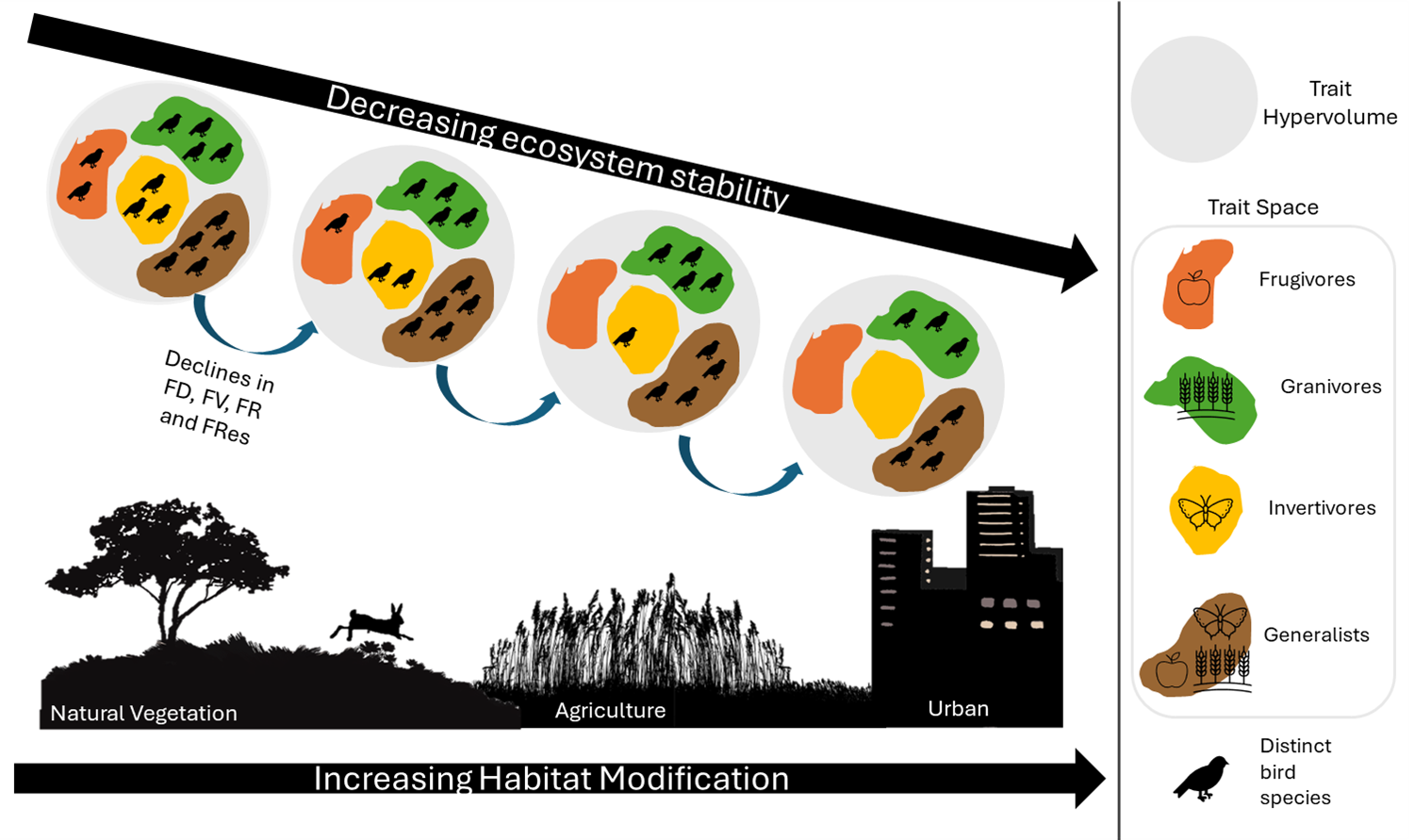
Figure 1 Infographic illustrating how increasing habitat modification (land-use change) reduces the functional diversity of bird assemblages, ultimately decreasing overall ecosystem stability. Black arrows indicate a general negative relationship between habitat modification and ecosystem stability. Blue arrows indicate changes in the trait hypervolume with increasing habitat modification. FD = Functional diversity, FV = Functional vulnerability, FR = Functional redundancy, FRes = Functional resistance. Grey circles represent trait hypervolumes, polygons represent unique trait spaces (functional groups), and each bird icon represents a distinct bird species. An unoccupied trait space reflects a loss of that functional role within the assemblage. Produced using PowerPoint and Canva.
However, not all species fulfil unique functional roles; many species within an ecosystem overlap in the roles they fulfil. For example, two distinct bird species may exploit the same prey species. This is known as functional redundancy. To account for this redundancy, Weeks et al.3 also compared the positions of all species’ traits within a trait hypervolume (Figure 1). A trait hypervolume is a multidimensional plot used to visualise the full range of functional traits occupied by a species, or, here, a bird assemblage, and can be used to compare where trait similarities cluster across different species within an assemblage. Functional redundancy was calculated as the average number of species that could be removed from the trait space without decreasing functional diversity. By doing so, Weeks et al.3 found that, like functional diversity, functional redundancy declines substantially across landscapes with increasing human modification (Figure 1). Without redundancy, an ecosystem is less resilient to further land-use changes, as the loss of even a single species could result in the loss of an entire functional role (Figure 1).
Nevertheless, these metrics alone are insufficient for quantifying ecosystem stability following land-use change, as they do not account for the sensitivities of some species to land-use change. Despite fulfilling unique functional roles, some species, particularly larger and rarer species or those with more specialised diets, are more sensitive to land-use change. 5 Weeks et al. 3 explain that, as ecosystem modification increases, the most sensitive species are the first to be lost, and that, with increasing ecosystem modification, losses in functional diversity are reduced, meaning functional vulnerability is reduced, since the species that persist in these modified environments possess traits that make them well adapted (Figure 1). However, when quantifying assemblage resistance to initial losses in functional diversity, they found that decreased functional vulnerability did not buffer against species losses in more heavily disturbed habitats.
Weeks et al. 3 show that functional diversity, redundancy, vulnerability, and resistance are all lowest in heavily modified landscapes. Regardless of functional vulnerability, land use change drives significant declines in ecosystem functioning. Yet land-use change disproportionately affects unique functional groups within bird assemblages (Figure 1). Frugivores, feeding on fruit, and invertivores, feeding on invertebrates, were found to be less suited to modified landscapes, whilst granivores, feeding on grain, and generalists, feeding opportunistically, thrived. This trend is primarily driven by the turnover in food resources across these environments, from abundant fruit trees to abandoned human food waste and plentiful seed-bearing grasses in agricultural areas or near human settlements.
Weeks et al.3 demonstrate that species loss is insufficient for understanding the true impacts of land use change on bird assemblage biodiversity and ecosystem stability. Functional values were estimated using simulated extinction scenarios, which introduce uncertainty into the resulting functional values. Nonetheless, the simulations were based on actual bird morphometric and abundance data obtained through field surveys. Weeks et al.3 focused on the functional diversity of bird assemblages, and the trends observed may not be conserved across other animal assemblages, such as mammals or insects. Therefore, as intensive land-use change continues worldwide, the instability of ecosystems should be further explored at a similar scale to quantify the extent to which land-use change is driving the simplification of our functional assemblages globally.
1. Brusatte, S. L., O’Connor, J. K. & Jarvis, E. D. The Origin and Diversification of Birds. Current Biology 25, R888–R898 (2015).
2. State of the World’s Birds (2022). BirdLife International https://www.birdlife.org/papers-reports/state-of-the-worlds-birds-2022/ (2022).
3. Weeks, T. L. et al. Land-use change undermines the stability of avian functional diversity. Nature 649, 381–387 (2026).
4. Tobias, J. A. et al. AVONET: morphological, ecological and geographical data for all birds. Ecology Letters 25, 581–597 (2022).
5. Newbold, T. et al. Ecological traits affect the response of tropical forest bird species to land-use intensity. Proc Biol Sci 280, 20122131 (2013).
Leave a Reply